



Thomas County keeps township road system, joins federal regulatory litigation
August 10, 2026
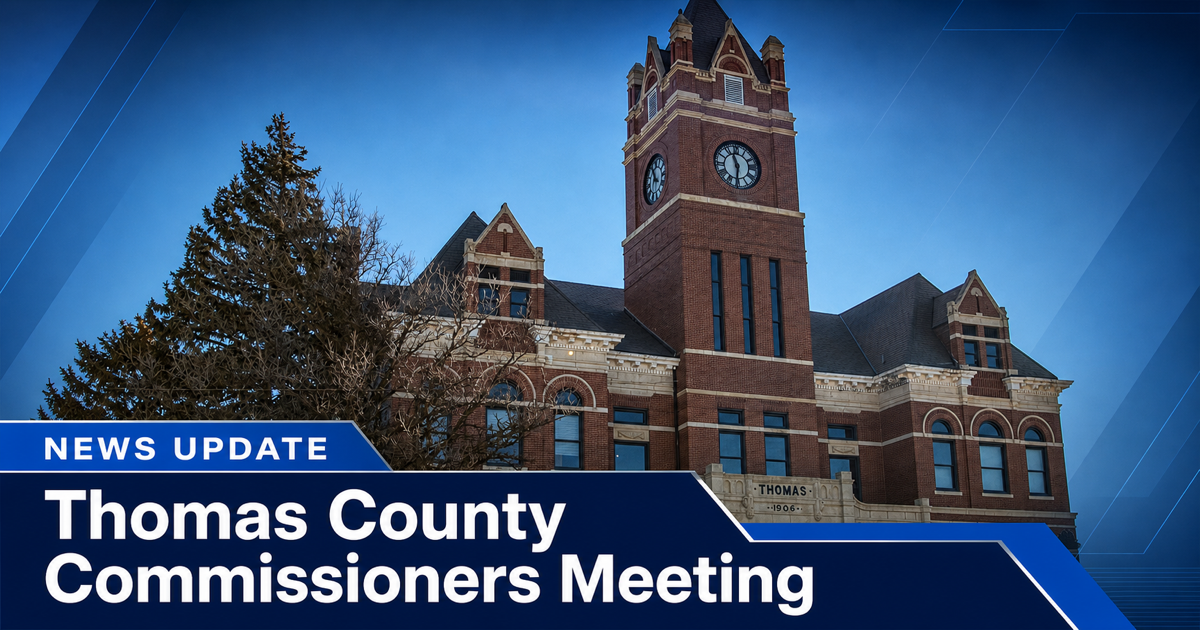
Thomas County commissioners rejected the idea of placing township roads under countywide control during their Aug. 10 meeting at the Thomas County Courthouse, siding with residents and county officials who said road decisions should remain close to the people affected by them.
Commissioners approved accounts payable in the amount of $113,411.75, prior to a discussion centered on a provision of Kansas law allowing commissioners to adopt a countywide road system by resolution. County Attorney Chris Rohr explained that the resolution would have to be published for three consecutive weeks and would take effect after 90 days unless a protest petition signed by 10% of the county’s qualified electors forced an election.
Under such a system, roads now maintained by townships would generally become the county’s responsibility. Unused township road funds would be transferred to the county treasurer and placed in separate funds for work within each township where the money originated.
North Randall Township resident Lonnie Wilson urged commissioners to retain the existing system. He said his township maintains approximately 63 miles of roads and questioned whether three county commissioners could effectively replace the numerous township board members who monitor local conditions.

Wilson estimated Thomas County could become responsible for more than 1,200 miles of township roads under a countywide system, potentially requiring additional employees, equipment and tax revenue. He suggested that individual townships struggling with road maintenance should decide separately whether to transfer that responsibility to the county.
Commissioners agreed, saying residents with road complaints should first document the problems and take them to their township boards. If those boards are unresponsive, residents can seek changes in township leadership or pursue the legal process for transferring road responsibilities.
“The best government is that closest to the people,” Chairman Mike Baughn said.
Road and Bridge Supervisor Clair Schrock also supported retaining local control. Commissioners acknowledged concerns about roads in some townships, including discussion of an exposed private gas line in a roadway, but said those issues did not justify assuming responsibility for every township road.
The board ultimately took no action on the proposed county road-unit resolution.
Commissioners also voted unanimously on two separate ballots authorizing the Kansas Natural Resource Coalition, or KNRC, to participate in federal litigation involving changes to Endangered Species Act regulations.
The first vote authorized the coalition to help defend the repeal of the U.S. Fish and Wildlife Service’s regulatory definition of “harm.” Coalition representatives said the former definition could treat certain habitat changes as an unlawful “take” of a protected species even when a landowner did not directly kill or injure an animal.
The second vote concerned repeal of the agency’s blanket Section 4(d) rule, which generally extended protections applied to endangered species to threatened species. KNRC argues that protections should instead be considered individually for each threatened species.

Pacific Legal Foundation offered to represent the coalition at no cost to KNRC or its member counties. Commissioners said the regulatory issues could affect agriculture, private property, county roads and other infrastructure. The Lesser Prairie-Chicken and its effect on land-use regulation were cited during a recorded presentation shown to the board.
Commissioners also reviewed a traffic investigation of the U.S. 24 and U.S. 83 intersection, commonly called Nine-Mile Corner. The report rated the intersection above the threshold for critical concern but found that traffic signals and an all-way stop were not warranted under applicable traffic standards.
Recommended improvements include adding stop bars on the northbound and southbound approaches, placing reflective tape on stop and warning signs, and replacing some 36-inch signs with larger 48-inch signs.
Route markers will be moved from the backs of stop signs, and “cross traffic does not stop” notices will be added where motorists waiting at the intersection can see them. The eastbound and westbound bypass lanes are also expected to be converted or modified into right-turn lanes.
County officials said implementation had begun but would take several weeks because some signs and materials must be ordered.
In other business, commissioners authorized Emergency Management Director David Becker to establish a committee to evaluate six anticipated proposals for county information-technology services. Representatives from the sheriff’s office, EMS, county clerk’s office, IT and county attorney’s office are expected to participate. Becker said proposals would be evaluated on service and other criteria rather than price alone.
The commission also removed a planned landfill-tonnage discussion from the amended agenda and approved the July 31 meeting minutes.