



Landfill pressures, 2027 budget dominate Thomas County Commission meeting
August 17, 2026
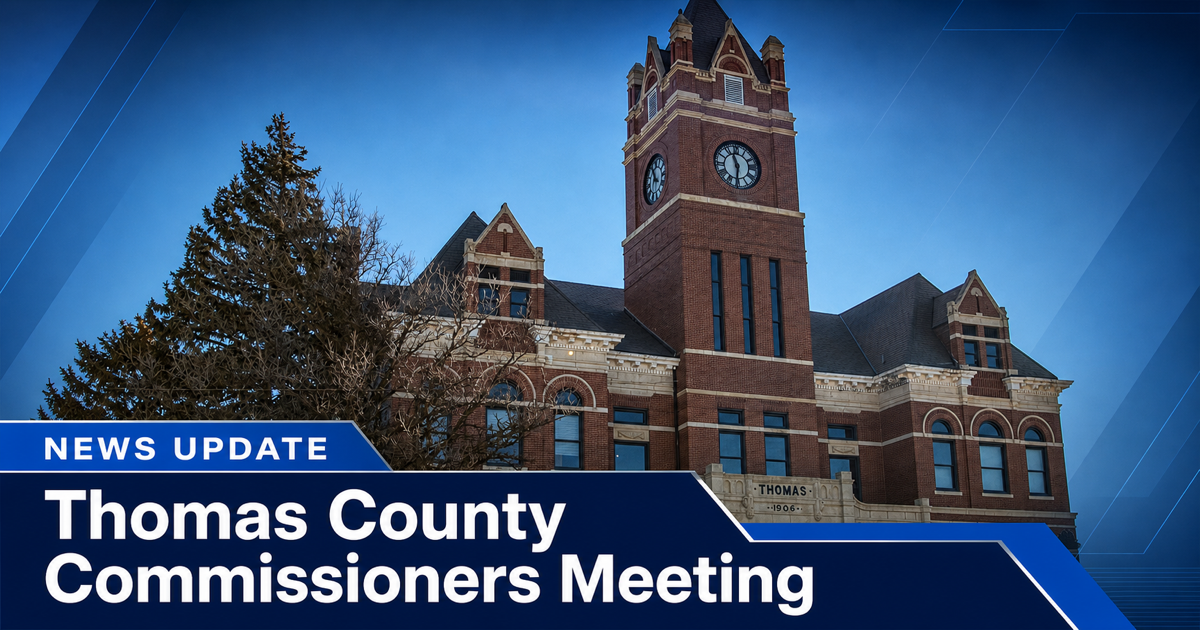
Thomas County commissioners approved a higher landfill rate for mixed City of Colby waste Monday morning as they addressed growing concerns about waste volumes and continued preparations for the county’s 2027 budget hearing.
The landfill discussion centered on the city’s decision to collect grass clippings with household trash instead of separating the material for composting. Because the combined load must be counted as municipal solid waste, the practice has increased the amount of regulated waste entering the county landfill.
The landfill’s operating permit allows an annual average of no more than 20 tons of municipal solid waste per day. Commissioners were told the city has recently delivered nearly 17 tons per day by itself, leaving little capacity for waste from other landfill users.
Although the landfill’s compliance is calculated on an annual average rather than month by month, officials said the higher summer volumes create concerns for the remainder of this year and for future years as Colby continues to grow.

Commissioners voted to authorize the landfill director to classify the city’s mixed waste as “dirty” waste. That designation increases the city’s rate from $54 per ton to $110 per ton when chargeable household trash and normally nonchargeable yard waste are mixed together.
The higher rate is intended to encourage the city to resume separating grass clippings from its regular trash. Commissioners said the city’s current collection method may be less expensive for the city in the short term, but it uses much of the landfill’s permitted capacity and could ultimately create substantially higher costs for all county residents.
If Thomas County exceeds the limits of its landfill permit, officials said the county could face state enforcement action or eventually be required to convert the facility into a transfer station. That would require trash to be unloaded, processed and transported elsewhere for disposal.
Commissioners were told such a conversion could cost at least $7 million and require additional equipment and employees, including a full-time driver. Garden City was identified during the discussion as the closest likely destination for transferred waste.
The board agreed that converting the landfill into a transfer station would not be a prudent option and that the county and city will need to find a long-term solution to yard-waste collection.
Budget work occupied much of the remainder of Monday’s meeting as commissioners prepared for a public hearing scheduled for 9 a.m. Sept. 8 at the Thomas County Courthouse.
The working 2027 budget calls for an estimated levy of 47.629 mills. That is 0.694 mills above the county’s calculated revenue-neutral rate of 46.935 mills. It is also slightly higher than the current levy of approximately 47.443 mills.
County Treasurer Layn Bruggeman reviewed more than $1.03 million in reductions already made from departmental and fund requests. Those cuts included approximately $612,000 from Road and Bridge, $90,550 from the landfill, $63,015 from appropriations, $54,700 from the jail and $41,700 from emergency medical services, along with reductions in several other county budgets.
Despite the cuts, employee benefits, EMS, the Sheriff’s Office, the Jail, Courthouse General and Noxious Weed were among the areas showing increases.
The county expects to budget nearly $5.4 million in nontax revenue for 2027, compared with approximately $4.9 million in the previous budget. Bruggeman said those anticipated revenues have helped hold down the proposed property-tax levy.
Commissioners discussed whether to take approximately $115,000 from reserves to reach the revenue-neutral rate. The commissioners’ reserve fund currently contains about $1.9 million. After accounting for money already included in the proposed budget and an expected reimbursement from sales-tax revenue connected to the wind project, the fund is projected to contain about $2.1 million.
Using reserves would have lowered the estimated levy to about 46.900 mills. Commissioners ultimately rejected that approach, expressing concern that using one-time reserve money for continuing expenses would leave the county starting from behind in future budget years.
Chairman Mike Baughn said the relatively small increase should be weighed against the risk of cutting too deeply and later being forced to make a much larger levy increase. Commissioners also expressed concern that the Kansas Legislature could impose additional property-tax restrictions on local governments.
The board reached a consensus to take the proposed 47.629-mill levy into the Sept. 8 hearing. Final action on the budget will follow the public-hearing process.
Commissioners also discussed reductions in county support for senior centers and other community organizations. Baughn said many of those programs were initially supported by federal or state funding before the financial responsibility shifted to counties. He suggested that communities wishing to maintain services such as senior centers, libraries or historical organizations may need to identify more local sources of support.
Earlier in the meeting, Developmental Services of Northwest Kansas President and CEO Jerry Michaud presented the organization’s 2027 funding request. DSNWK is asking the county to maintain its annual contribution of $88,500.
Michaud said DSNWK served 21 Thomas County residents during 2025 and faced a local funding gap of slightly more than $49,000 for those services. The organization serves approximately 561 people across its 18-county region.
He also described continuing workforce shortages and a statewide waiting list of more than 5,300 people seeking intellectual and developmental disability services. The wait for services is approaching 10 years in some cases with Thomas County residents making up 153 of those waiting.
In other business, the county reported receiving a $743,375.36 payment from the Solomon Forks Wind Project. Commissioners also approved accounts payable totaling $32,329.10 for Road and Bridge and $23,209.01 for Courthouse General.