


Two Thomas County Flock cameras cut down; sheriff seeks public’s help
August 21, 2026
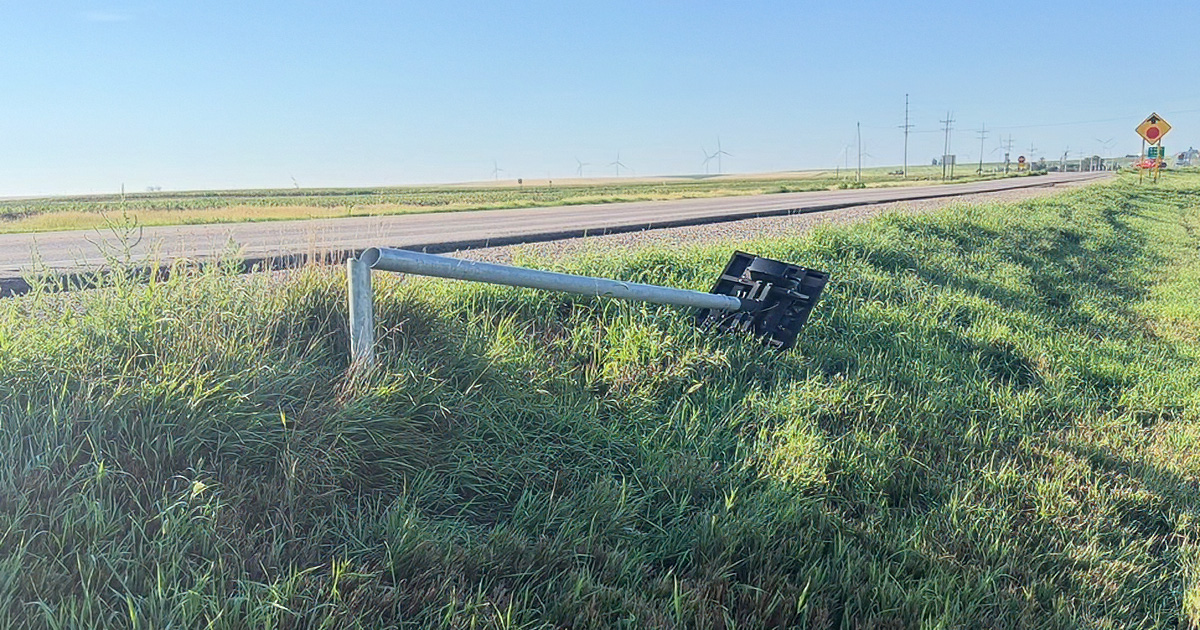
Two automated license plate-reading cameras operated by the Thomas County Sheriff’s Office were cut down Thursday night, causing damage that authorities expect will exceed the threshold for a felony criminal damage case.
Sheriff Tom Nickols and Undersheriff Kirt Nichols Jr. said the cameras were damaged between approximately 9:30 and 10:30 p.m. Aug. 20 near the junction of U.S. highways 24 and 83, commonly known as the Nine-Mile Corner east of Colby.
Investigators believe someone used a reciprocating saw to cut through the cameras’ mounting poles. Both poles were knocked down, and at least one camera sustained an estimated $850 in damage.
The full cost remains unknown. Reinstalling the equipment is expected to require coordination with the Kansas Department of Transportation and Flock Safety, the company that supplies and services the cameras. Those expenses will likely fall to Thomas County.
No suspects had been identified as of Friday.
The Sheriff’s Office is asking anyone who saw a suspicious person or vehicle in the area during the estimated time frame to call 785-460-4570. Tips may be made anonymously.
Nickols said the combined cost of repairing the camera, replacing or resetting the poles and reinstalling the system is expected to result in a felony-level criminal damage investigation. Under Kansas law, damage totaling at least $1,000 but less than $25,000 can constitute a severity level 9 nonperson felony. Any charging decision would ultimately be made after the investigation and review by prosecutors.

Cameras purchased with forfeiture funds
The cameras are two of four Flock units the Sheriff’s Office placed around Thomas County about two years ago. Nickols said they were purchased with money obtained through drug forfeitures rather than the county’s general operating fund.
One reason for installing the cameras was Thomas County’s location along highways used by north-south and east-west traffic. Nickols said the system has assisted investigations involving suspected drug trafficking.
The sheriff also credited the cameras with helping officers locate missing children and find older adults who were the subjects of Silver Alerts.
Unlike a conventional security camera that continuously records video of an area, the county’s Flock cameras capture still images and identifying details from passing vehicles. That information can include a license plate number, vehicle color, make, model and distinguishing features such as damage, decals or roof racks.
The system allows an investigator to search for a known plate or for a vehicle matching a description. It can also notify officers when a vehicle associated with a missing-person alert, stolen-vehicle report or other law-enforcement database passes a camera.
Nickols said Thomas County’s data is retained for 30 days and then deleted unless information has been preserved as evidence in a particular investigation. He said the system is not used to issue traffic citations or maintain a permanent record of routine traffic.
The company historically made 30 days its default retention period. On Aug. 13, however, Flock announced that it is changing its recommended default to seven days while adding an “Evidence Mode” through which records connected to active cases may be preserved. Flock said existing customers may retain their locally approved policies, meaning the announcement does not automatically change Thomas County’s 30-day practice.
Public-safety benefits and privacy concerns
Supporters of automated license plate readers say the technology gives officers a faster way to locate stolen vehicles, find missing or endangered people and develop leads after serious crimes. Instead of reviewing hours of conventional video, an investigator can search a database using a plate number or vehicle description.
The cameras can also provide an objective record of when and where a vehicle passed a particular location. That information may help corroborate other evidence, but a camera match alone does not establish that a vehicle’s owner was driving or that anyone inside committed a crime.
Privacy advocates contend that the same capabilities can be used to reconstruct people’s movements even when they are not suspected of wrongdoing. Cameras photograph vehicles indiscriminately, and concerns increase when records can be searched or shared among numerous agencies.
The American Civil Liberties Union has argued that large, interconnected license plate-reader networks can reveal sensitive patterns about where people travel. The organization has also raised concerns about inaccurate matches, data sharing and the possibility of officers using the system for unauthorized purposes. A pending federal case in Virginia is examining whether extensive use of Flock cameras may violate drivers’ Fourth Amendment privacy rights.
Kansas law recognizes captured license plate information—including the plate number, photograph, time, date and location—as a distinct category of data under the Kansas Open Records Act. A broader 2021 proposal that would have required Kansas law-enforcement agencies to adopt detailed written policies governing the technology died in committee.
Nickols said access to the Thomas County system is closely supervised. He and Nichols review the system’s audit logs, including searches conducted by deputies. Nickols said improper personal or unauthorized use would result in termination and criminal charges.
The sheriff encouraged residents with questions about how the cameras operate or how the data is used to contact his office.
Anyone with information about the destruction of the two cameras may call the Thomas County Sheriff’s Office at 785-460-4570.