



Thomas County weighs license-plate cameras, transmission project
August 31, 2026
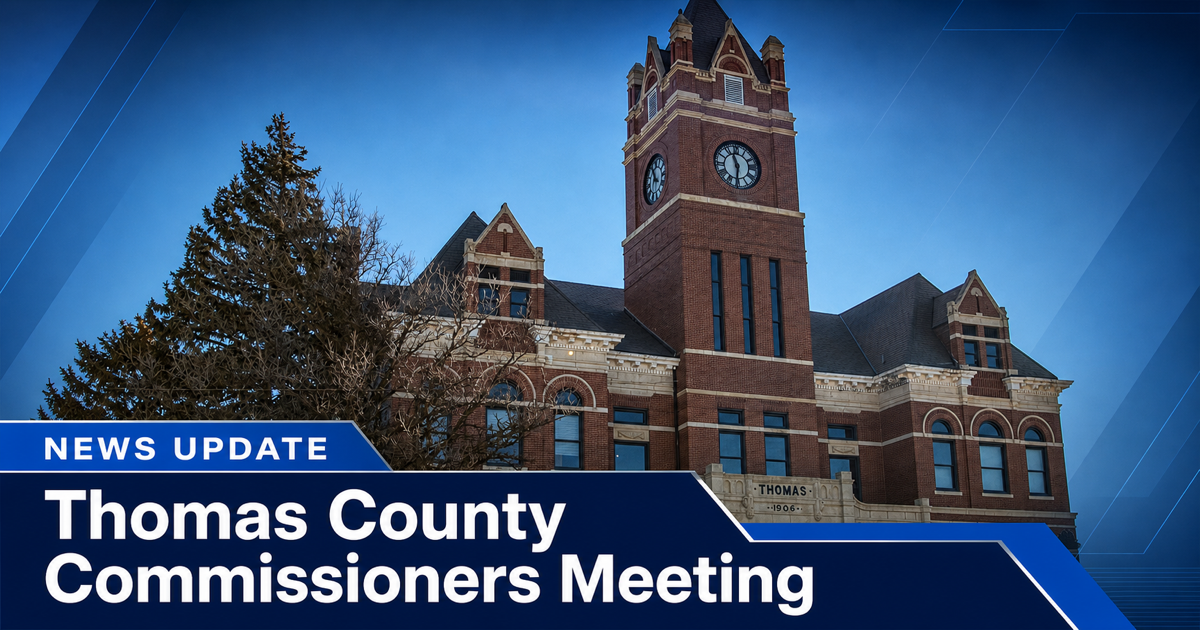
Thomas County commissioners heard a defense of the sheriff’s automated license-plate readers Monday amid public concerns over privacy, data retention and the replacement of two cameras that were recently damaged.
Thomas County Sheriff Tom Nickols addressed commissioners Monday about the sheriff’s office’s use of Flock Safety automated license-plate readers, following public discussion about the cameras and recent damage to county equipment.
Automated license-plate recognition systems, commonly called ALPRs, use cameras and software to convert images of license plates into searchable data. Under Kansas law, captured plate data can include the plate number, photograph, date, time, GPS coordinates and other information captured or derived from the system.
Nickols said Thomas County initially operated six cameras. He said one camera along Kansas Highway 25 was disabled when its wiring was pulled and two camera poles near Nine Mile Corner were cut down. He estimated the damage to each camera at between $900 and $1,000, apart from the poles and costs associated with reinstalling the equipment.
Nickols said the cameras were purchased with drug-forfeiture funds rather than the county’s general fund. He did not ask commissioners to approve replacement cameras Monday, describing his appearance as informational and an open discussion.
What the cameras record
Nickols said Thomas County’s cameras photograph license plates and vehicle characteristics, but do not use facial recognition or identify vehicle occupants.
Flock states that its standard license-plate readers identify plates and vehicle characteristics while not using facial recognition or biometric identification. The company also says its software can search by vehicle make, model, color and distinguishing features. Flock’s published data-deletion explanation describes what the company says its system collects, how the information is stored and what it does not identify.
That distinction does not mean the system operates without algorithms. Optical character recognition is used to convert a photographed plate into searchable characters, and software can classify other vehicle attributes. Kansas’ statutory definition of an ALPR specifically refers to cameras being combined with computer algorithms.
Nickols said deputies can enter a plate or vehicle description connected to an investigation. He said the system can also alert officers when a plate matches a law-enforcement list involving a stolen vehicle, wanted person or missing-person alert.
Flock says its system provides real-time alerts from national and state hot lists but also states that officers should independently verify a match before taking enforcement action. The company’s August 2026 description of its safeguards says that an alert should not be the sole basis for a vehicle stop.
Nickols credited the cameras with helping deputies locate missing and endangered people, including a man whose family had been unable to find him for approximately three weeks. He said the system had also helped locate runaway children, develop leads in drug investigations and disprove an allegation that could otherwise have resulted in criminal charges.
Retention and ownership
Nickols said Thomas County owns the information collected by its cameras and was using a 30-day retention period. He said he and Undersheriff Kirt Nichols would consider shortening that period, although he expressed concern that seven days may not be long enough when crimes or suspicious activity are reported late. He said 14 days might be a workable alternative.
Flock’s published policy supports part of that description but adds an important distinction: the company says customers own and control their data, while the data is transmitted to and stored in Flock’s cloud environment using Amazon Web Services. According to Flock’s privacy policy, customer data is encrypted in transit and at rest, and searches by authorized law-enforcement users require a stated justification that creates an audit trail.
On Aug. 13, Flock announced that it was changing its recommended default retention period for new deployments from 30 days to seven days. The company said existing customers may retain their previously selected periods, which is consistent with Nickols’ statement that Thomas County remained on a 30-day setting.
Flock also says particular records may be preserved as evidence in an active case or retained when required by law, legal process or a customer agreement. Accordingly, a standard retention period does not necessarily mean every record connected to an investigation is deleted at the end of that period.
Access, audits and sharing
Nickols said seven sheriff’s office employees were authorized to use the system. He said users receive individual credentials after completing training and that the department reviews search to identify possible misuse.
Nickols also said a search must be associated with an investigation or case and that requests from outside agencies are reviewed before access is granted. He said Thomas County did not share its cameras with out-of-state agencies.
Flock says every search is connected to an individual user and recorded with the time and stated reason. Its law-enforcement access policy says sharing is optional and controlled by the customer agency. The company announced in August that it would make automated misuse detection mandatory for law-enforcement customers by the end of 2026 and expand requirements for case codes, multi-factor authentication and administrative review.
Those are the company’s published policies and product descriptions. Whether each safeguard is active in Thomas County would depend on the county’s contract, system settings and department policy.
County responds to proposed transmission route
Commissioners also reviewed Sunflower Electric Power Corporation’s proposed route for the Holcomb-to-Sidney 345-kilovolt transmission project.
Sunflower filed its preferred route with the Kansas Corporation Commission in August. The broader project would construct approximately 360 miles of transmission line between Holcomb, Kansas, and Sidney, Nebraska, with about 180 miles assigned to Sunflower. The Southwest Power Pool directed the project as part of an effort to increase grid capacity and improve reliability during extreme weather.
The preferred route crosses portions of Finney, Scott, Wichita, Logan, Thomas, Sherman and Cheyenne counties and remains subject to KCC review. The route shown to commissioners passes through a portion of southwestern Thomas County before continuing toward Sherman County.
Jim Weed of Kingery Township said residents he had spoken with were generally opposed to the proposed route. He raised concerns about the line crossing a high-pressure natural-gas pipeline and said landowners had received information indicating some lines could be only 14 feet above the ground.
Weed said that height could interfere with combines, sprayers, trailers and oilfield equipment. He acknowledged that he did not have printed documentation confirming the proposed clearance.
Road and Bridge Supervisor Clair Schrock noted that the transmission line would cross several county roads, making county involvement important as engineering and construction plans develop.
Commissioners directed County Attorney Chris Rohr to work on a possible letter or resolution communicating residents’ concerns to the KCC. The response could request changes, including adequate line clearance at agricultural and road crossings.
Sunflower has said affected landowners will receive information about public hearings and opportunities to participate in the KCC review process.
Mitigation plan adopted
Commissioners unanimously adopted Resolution 2026-13, formally approving the Kansas Homeland Security Region A Hazard Mitigation Plan.
Emergency Management Director David Becker said the federal review process was delayed by problems at the Federal Emergency Management Agency. FEMA and the Kansas Division of Emergency Management have now approved the regional plan contingent upon adoption by participating local governments.
Having an adopted plan allows Thomas County to seek federal mitigation grants for projects intended to reduce damage before disasters occur. Becker said those grants generally provide 70% of a project’s cost, with a 30% local match.
In response to questions from Schrock, Becker said the program could assist with projects such as replacing a bridge identified as vulnerable through routine inspections or addressing infrastructure in a floodplain.
Becker will also contact participating cities, schools, the hospital, Colby Community College and other local agencies that must consider adopting the plan.
Commissioner Brian Luedke will review a request for Thomas County to appoint a representative to the NEK-CAP Inc. Board of Directors and plans to make a recommendation at a future meeting.
Commissioners approved $253,452.34 in Courthouse General accounts payable and $145,519.52 for Road and Bridge. They also approved the Aug. 10 and Aug. 17 meeting minutes and August payroll totaling $553,432.46.
The commission entered a 20-minute executive session concerning non-elected personnel in the Health Department and later held a 15-minute executive session with representatives of the sheriff’s office. Commissioners returned to open session without taking binding action after either session.
Commissioner Brad Flipse left the meeting at approximately 9:45 a.m. to attend a funeral. The meeting adjourned at approximately 10:48 a.m.
Mike Baughn's Statement on Automated License Plate Readers
I believe automated license plate readers, or ALPRs, used by law enforcement agencies are another investigative aid in law enforcement’s arsenal for combating criminal behavior.
The ACLU, limited-government conservatives and privacy advocates have claimed that ALPRs constitute a Fourth Amendment violation. The ultimate arbiter of the constitutionality of such investigative tools is the Supreme Court—not backroom, limited-intelligence social media commentators.
Courts have consistently held that people traveling on public roads, in plain view, have no reasonable expectation of privacy. Courts have also found that merely observing an object in plain view does not implicate the Fourth Amendment.
Law enforcement agencies use automated license plate readers for a variety of proactive and reactive policing purposes, including gathering intelligence and evidence, identifying potential suspects and facilitating crime analysis.
ALPRs create point-in-time observations consisting of still images captured at fixed locations. They do not track the whole of a person’s movements or provide a complete window into an individual’s daily life.
The public-safety value of these systems in finding missing people, recovering stolen vehicles and identifying vehicles linked to violent crimes is real. Agencies can enable hot-list alerts for vehicles associated with Amber Alerts, Silver Alerts, stolen vehicles and other law enforcement notices, but the cameras do not provide continuous following.
Thomas County’s Flock system currently has a 30-day retention period, which prevents data from accumulating over an extended period. Personally, I would like to see that changed to a retention period of seven to 14 days.
Regarding the purchase and installation of Flock ALPRs in Thomas County, Kansas law gives the elected sheriff distinct executive control over law enforcement operations, while the County Commission retains authority over the county’s general budget and appropriations. We can certainly make recommendations to other elected county officials, but we do not micromanage their operations and decisions.
The Sheriff’s Office advised the commission of the installation of the ALPRs and explained their purpose. Whether the sheriff chose to pay for them with drug-forfeiture funds or from his approved budget was his decision. The commission has no statutory authority to direct law enforcement operations beyond ensuring that county expenditures are properly budgeted.
I have concerns about the potential misuse of ALPR cameras and hope the Legislature establishes strict criminal penalties for law enforcement officers who misuse the data. Such a violation should be classified as a felony, and an offending official should lose all law enforcement authority.
I am also concerned about cameras collecting and sharing information in a manner that could turn them into tools of state surveillance. How the data is used, how long it is retained and how securely it is maintained are vital concerns. As long as provable safeguards are in place and the cameras are being used to pursue criminals, I support their use.
The ACLU and others argue that continuously networked plate scanners could, over time, reveal which doctors people visit, where they worship, whom they visit or travel with, and which political meetings or protests they attend. I believe those concerns are pure hogwash. I drive past a Flock camera several times a week and do not fear that my rights are being violated. In my opinion, most people who are not flouting the law have no valid constitutional concerns.
I nevertheless have significant concerns about artificial intelligence and the broader use of technology in law enforcement. Our national and state legislators must focus more closely on standards and security for investigative tools. I worry that, as a nation, we are moving closer to a system in which the federal government can track and control the movements of individual citizens.
Mike Baughn
Chairman, Thomas County Commission