



Ag After Hours Tackles Stress and Misinformation in Colby
January 8, 2026
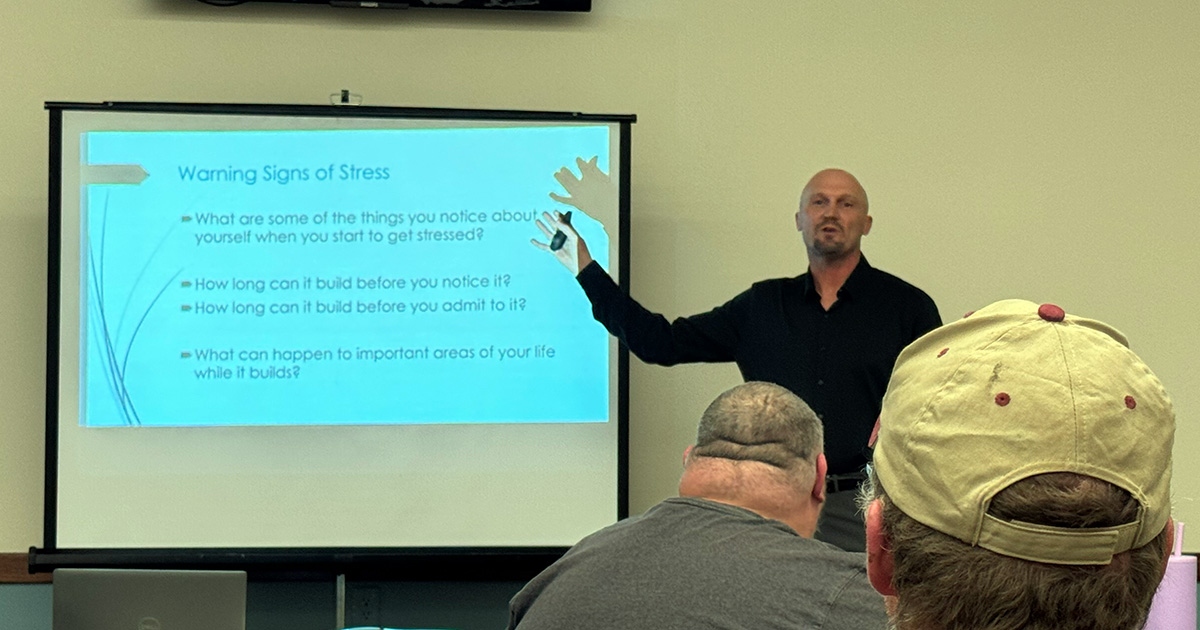
The Kansas State Research and Extension office hosted its January Ag After Hours gathering on Wednesday evening, Jan. 8, at Columbus Hall in Colby, bringing together just over 20 members of the local agricultural community for an event designed to be equal parts educational and social, with a fantastic meal served from By Galli Catering to begin the evening.
The informal format encouraged conversation and connection, while still delivering timely, practical information relevant to producers navigating both the operational and personal challenges of modern agriculture. The evening featured two presentations that addressed very different, but increasingly important, realities facing the ag industry: managing stress and evaluating information in an era of widespread misinformation.
The first presentation was led by Will Stutterheim of the psychology department at Fort Hays State University, who spoke about stress in agriculture and the mental toll it can take on individuals and families. Stutterheim opened by sharing a personal story from his childhood, recalling the first time he experienced agricultural stress firsthand when his family farm received an eviction notice on Christmas Day while he was in third grade. That moment, he explained, shaped his long-term interest in understanding how stress affects farm families and rural communities.
Throughout the discussion, Stutterheim emphasized that stress often builds gradually and can go unnoticed until it begins to interfere with daily functioning. He walked the group through common warning signs, encouraging participants to reflect on their own experiences and openly discuss how stress manifests in their lives. The conversation was notably interactive, with attendees contributing observations and examples from their own operations and households.
Click below to support The Sunflower Standard

A key portion of the presentation focused on how the brain responds to stress. Stutterheim explained the concept of two competing mental systems: a reflective system responsible for planning, problem-solving, and emotional regulation, and a reflexive system tied to fight, flight, or freeze responses. When stress escalates, he noted, the reflexive system can hijack behavior, leading to impaired decision-making and emotional overload. He stressed the importance of protecting emotional regulation, describing it as the foundation that supports all other mental functions during high-pressure situations.
Despite the seriousness of the topic, Stutterheim’s delivery was approachable and engaging, often using humor to keep the room at ease. He also offered practical strategies for managing stress, including simple techniques for calming a racing mind. One suggestion that resonated with many in attendance addressed the common issue of waking up in the early morning hours with persistent thoughts. Writing those thoughts down and removing visible clocks from the bedroom were shared as small but effective steps toward better rest.
An observable dynamic in the room was the difference in how stress was discussed among couples, with several attendees noting that wives appeared more willing to engage in conversations about stress, while many husbands leaned toward the traditional “I’m fine” mindset. The open setting of the event allowed that contrast to be acknowledged without judgment.
The second presentation of the evening was delivered by Helen Giefer from Kansas State Research and Extension, who addressed the growing challenge of misinformation in agriculture. Her session focused on helping producers critically evaluate research and product claims before making purchasing or management decisions.
Giefer outlined four foundational questions to ask when reviewing research: who conducted the study, who participated, whether statistical analysis was used, and whether the results were statistically significant. She explained how bias can enter studies and why understanding sample size, controls, and methodology is essential. The goal, she said, is not to turn producers into statisticians, but to give them tools to avoid being misled by incomplete or illegitimate claims.
The presentation was well received, particularly as many in the room acknowledged the increasing volume of products and information competing for attention in the ag marketplace. Ensuring that decisions are based on sound research, rather than marketing alone, was a theme that resonated strongly.
The Ag After Hours event concluded with informal conversation, reinforcing its purpose as a space for learning, discussion, and community connection. By pairing mental health awareness with practical research literacy, the evening highlighted the evolving support role Kansas State Research and Extension continues to play for agricultural producers across the region.