



Prairie Museum of Art and History Hosts Packed “Food for Thought” on Volga German Heritage
February 19, 2026
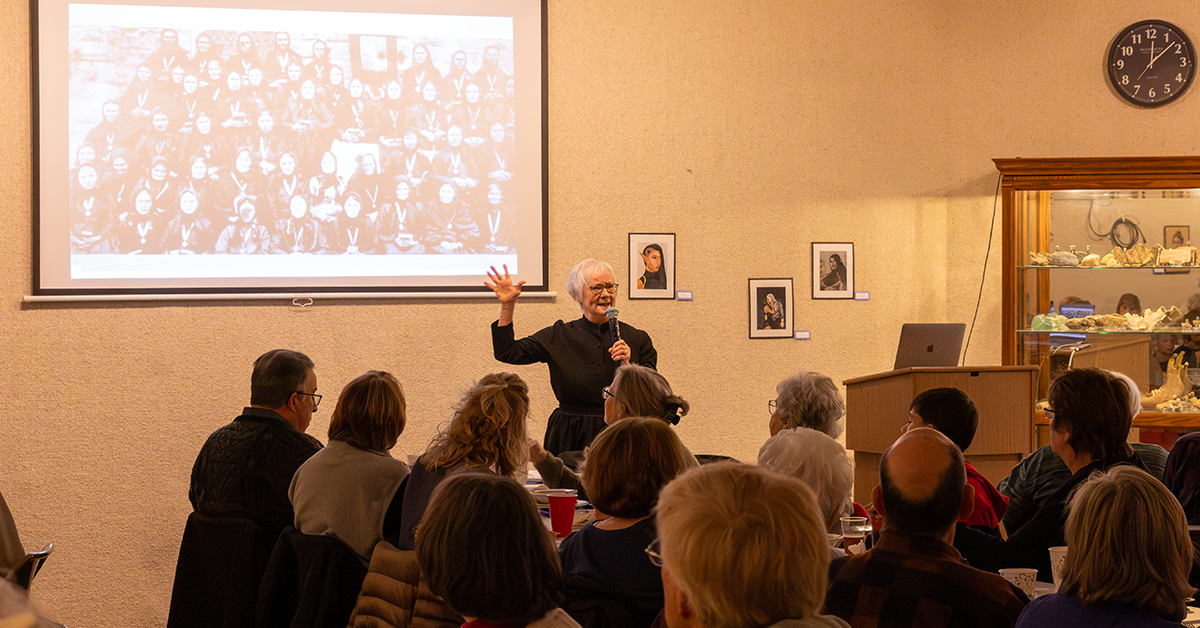
On a rare cold February afternoon in Colby, nearly 70 guests filled the Garvey Room at the Prairie Museum of Art and History for its monthly Food for Thought luncheon. Despite the weather, the aroma of a homemade German-inspired buffet welcomed attendees on February 19, as Norma Pipkin delivered an engaging and deeply personal lecture on the journey of the Volga Germans and their eventual settlement in Kansas.
Guests were treated to a meal that reflected the heritage being discussed: Genebble soup, bierocks, German chocolate cake, yellow cake and rhubarb whip. The comfort food paired naturally with a story rooted in perseverance, faith and cultural identity.
Pipkin, a proud Ellis County native with both sides of her family tracing directly to Volga German ancestry, brought not only research but lived experience to the podium. Introduced as a retired French and German teacher and a lifetime member of the American Historical Society of Germans from Russia, she immediately connected with the audience through family photographs and personal reflections.
One of the most striking visuals she shared was an 1892 photograph taken outside a Catholic church in Munjor, Kansas. The image featured dozens of women, all dressed in nearly identical black garments with aprons and head coverings. The uniformity, Pipkin explained, reflected practicality and tradition rather than fashion. The dresses were worn not just for Sunday services but for daily labor in fields and homes. Black fabric was durable, easier to maintain and often dyed at home. The apron served as both tool and necessity, used to carry goods and wipe children’s faces.

But the clothing was only the beginning of a much longer story.
Pipkin traced the origins of the Volga Germans back to 1763, when Catherine the Great of Russia issued a manifesto inviting Germans suffering under war, poverty and military conscription in the Holy Roman Empire to settle along the Volga River. She promised free land, exemption from military service and freedom of religion. Approximately 25,000 Germans accepted the offer, enduring difficult travel to St. Petersburg before relocating to the harsh and largely undeveloped Volga region.
Life in Russia proved grueling. Promised supplies were often delayed. Many families dug homes into the earth to survive brutal winters. Criminal exiles and nomadic tribes created additional danger. Yet within a few years, the settlers established more than 100 villages, divided primarily between Catholic and Lutheran communities.
For nearly a century, they retained their language, customs and faith.
By the 1870s, however, the Russian government reversed earlier privileges. Mandatory military service was reinstated under Tsar Alexander II, violating the original agreement that had drawn them to Russia. Faced with this change, Volga German leaders convened and sent delegates to North America to scout potential new homes. Nebraska was initially explored, but western Kansas offered affordable land at $2 per acre near Hays.
Between 1875 and 1878, families financed their own passage to the United States, often arriving with little money. They established communities including Liebenthal, Catherine, Herzog, Pfeifer, Munjor and Schoenchen. Notably, they avoided settling directly along railroad lines, preferring isolation to preserve language, religion and tradition. Churches were frequently constructed before homes, underscoring the central role of faith.
Pipkin emphasized that what makes this immigrant group unique is not just the double migration from Germany to Russia and then to Kansas, but their ability to maintain a dialect and cultural identity spanning 250 years. While much of the language has faded, remnants remain in Ellis County households today.
The lecture concluded with discussion of the 150th anniversary of Volga Germans arriving in Ellis County in 1876. Upcoming commemorative events include an international convention in Hays this August, a heritage play and a traditional polka dance celebration.
The afternoon ended with thoughtful questions from the audience, ranging from dialect differences to wheat production and cultural customs. Pipkin answered each with enthusiasm, humor and clear pride in her heritage.
In many ways, the story she told mirrored the resilience of those early settlers: hardship met with grit, isolation balanced with faith, and challenges overcome through community. On a cold winter day in Colby, that legacy felt very much alive.